
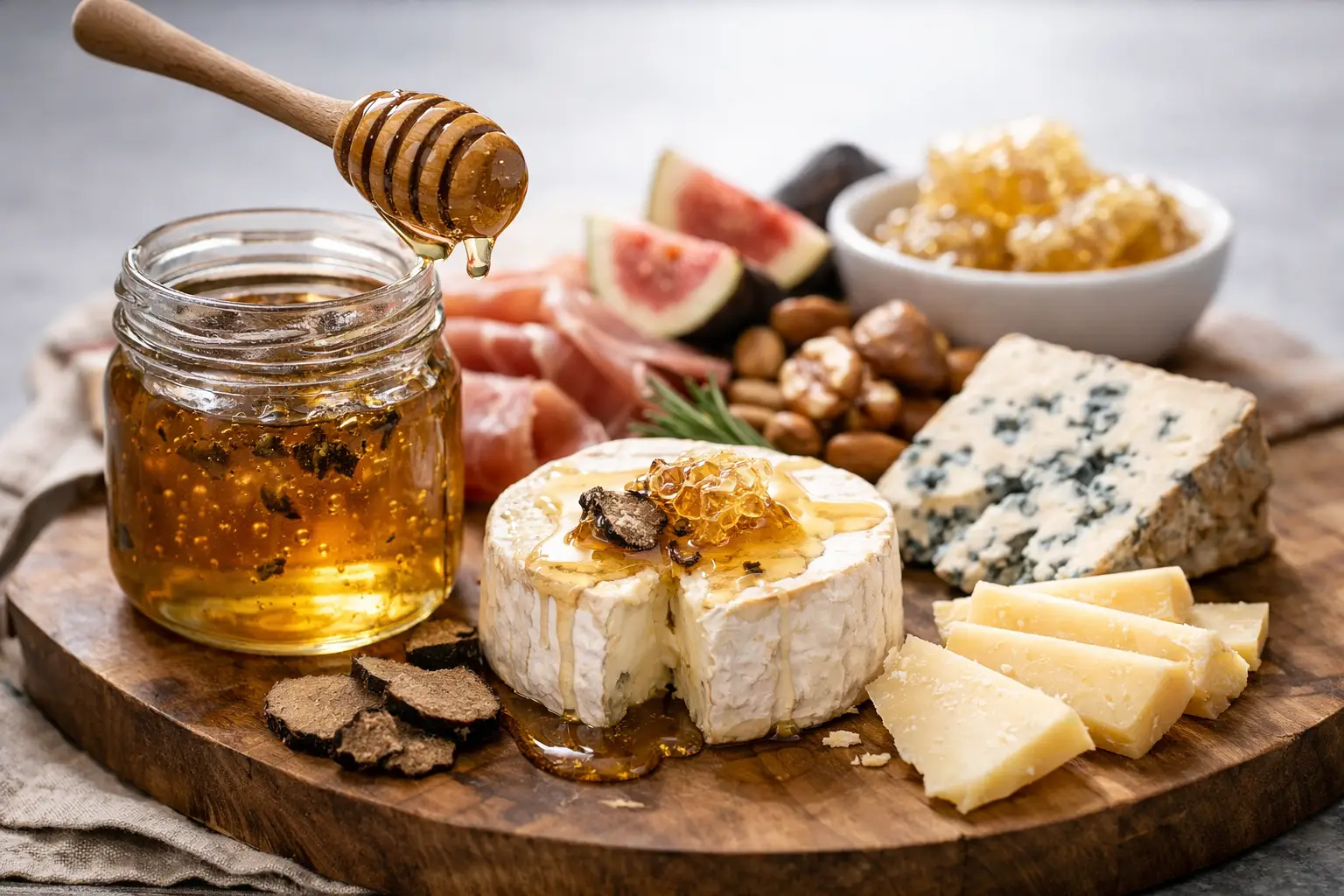
Best Truffle Honey Cheese Pairings for a Board 1
A spoonful of truffle honey changes the character of a cheese board instantly. Its floral sweetness rounds out salty, tangy cheeses, while the earthy perfume of truffle adds the kind of depth usually reserved for a fine restaurant course. The best truffle honey cheese pairings are not simply about placing a luxurious condiment beside cheese. They rely on balance: richness against acidity, sweetness against salt, and enough texture to carry every luscious bite.
For an easy but memorable first course, choose three to five cheeses with distinct styles rather than several versions of the same creamy profile. Let the honey arrive at the table at room temperature, and serve the cheeses slightly softened, never ice-cold. That small detail allows their aromas to bloom alongside the truffle.
Best Truffle Honey Cheese Pairings by Style
Triple-Cream Brie or Camembert
Soft-ripened cheese is one of the most generous partners for truffle honey. A ripe Brie brings butter, mushroom, and a gentle lactic tang, while Camembert offers a deeper, slightly rustic character. Both echo the woodland notes in truffle without competing with them.
Spoon truffle honey directly over a wedge just before serving, then add a slice of toasted country bread or a plain, crisp cracker. A few toasted hazelnuts make the pairing feel especially complete, bringing an earthy crunch that keeps the richness from becoming heavy. Choose Brie when you want a milder, silkier experience; choose Camembert when the board calls for more savory intensity.
Fresh Goat Cheese
The bright acidity of fresh chèvre is a beautiful counterpoint to truffle honey’s warm, savory sweetness. This is one of the most useful pairings for entertaining because it has immediate contrast: creamy cheese, fragrant honey, and a lively tang that refreshes the palate.
Serve a log of goat cheese with honey drizzled across the top, finished with cracked black pepper and a small handful of pistachios or almonds. It is equally at home on a composed cheese board, crostini, or a warm salad of roasted beets and bitter greens. If your honey is especially aromatic, keep the accompaniments restrained. The cheese and truffle deserve the attention.
Aged Pecorino
Aged sheep’s milk cheese has the salt, nuttiness, and concentrated flavor needed to stand up to black truffle honey. Pecorino is particularly compelling because its savory finish sharpens the sweetness rather than disappearing beneath it. The result is bold, elegant, and unmistakably Italian in spirit.
Break Pecorino into irregular shards instead of cutting neat slices. The craggy edges catch the honey and give each piece a more luxurious texture. Add ripe pear or thin apple slices for freshness, plus toasted walnuts for a polished finish. This pairing also makes an exceptional after-dinner bite with a glass of full-bodied red wine.
Parmigiano Reggiano
Parmigiano Reggiano and truffle honey are proof that a few well-chosen ingredients can create a special occasion. The cheese delivers crystals, browned butter, and a long savory finish, while the honey softens its saltiness with floral sweetness and truffle depth.
Use a well-aged wedge, ideally one with enough maturity to crumble cleanly into bite-size pieces. Drizzle lightly rather than flooding the cheese. Parmigiano’s flavor is complex, and a thin ribbon of honey is all it needs. Offer it with Marcona almonds, roasted grapes, or paper-thin slices of prosciutto for a board that moves effortlessly from cocktail hour to dessert.
Blue Cheese
Blue cheese is the dramatic choice, and it rewards a confident hand. Its peppery, tangy character creates a classic sweet-and-salty contrast with honey, while truffle adds a dark, earthy layer underneath. A creamy Gorgonzola Dolce is especially inviting, though Stilton or Roquefort can be excellent when guests enjoy more assertive cheese.
Because blue cheese can dominate, pair it with a milder cracker or a slice of fresh baguette. Fresh figs, walnuts, and a small pour of dessert wine are natural companions. Use less honey than you might with Brie: the goal is to frame the blue cheese, not conceal its distinctive personality.
How to Build a Truffle Honey Cheese Board
A refined board needs contrast, but it does not need excess. Start with a soft cheese such as Brie, a bright cheese such as goat cheese, a firm aged choice such as Pecorino or Parmigiano Reggiano, and one blue cheese if your guests appreciate bolder flavors. This progression gives everyone an easy place to begin and a more adventurous bite to discover later.
Place truffle honey in a small bowl with a serving spoon rather than drizzling it over every cheese in advance. Guests can control the intensity, and the board stays visually clean. This matters particularly with delicate cheeses, where too much honey can blur texture and flavor.
Choose accompaniments that contribute a purpose. Toasted nuts echo truffle’s earthiness. Pears, apples, figs, and grapes lend brightness. Salumi adds salt and richness, but it is optional, especially when the cheeses are already full-flavored. For crackers and bread, favor neutral, crisp choices over heavily seasoned varieties. Garlic, rosemary, and strong spice blends can distract from the truffle aroma.
Temperature is another quiet mark of a well-composed board. Remove cheese from refrigeration 30 to 45 minutes before serving, depending on the size of the wedges and the warmth of the room. Chilled cheese mutes flavor, while room-temperature cheese reveals the creamy, nutty, and grassy notes that make truffle honey taste even more nuanced.
White or Black Truffle Honey?
The answer depends on the cheese and the mood of the occasion. Black truffle honey tends to feel deeper and more woodsy, making it especially suited to aged Pecorino, Parmigiano Reggiano, blue cheese, and mushroom-forward Brie. It brings a savory, lingering character that holds its own beside substantial flavors.
White truffle honey is often more aromatic and delicately garlicky. It is a compelling choice with fresh goat cheese, mild bloomy-rind cheeses, and buttery young sheep’s milk cheeses. If the board includes sparkling wine, white truffle honey can be particularly graceful, since its fragrance is lifted by the wine’s freshness.
There is no need to treat either style as precious or difficult. A quality truffle honey is a finishing ingredient, meant to be tasted and adjusted. Begin with a small spoonful, then add more only when the cheese calls for it.
Pairing Truffle Honey Beyond the Board
These pairings translate naturally into simple, impressive dishes. Warm Brie topped with truffle honey and hazelnuts becomes an effortless centerpiece for a dinner party. Goat cheese crostini with honey and pepper makes a sophisticated passed appetizer. Shaved Pecorino over arugula, dressed with lemon and finished with a measured drizzle of honey, turns an everyday salad into something far more memorable.
For a richer course, add truffle honey to a grilled cheese made with Fontina or taleggio, or use it as a final touch on a pizza with mozzarella, prosciutto, and arugula. The key is restraint. Truffle is most exquisite when its aroma arrives as a finishing note, not when it overwhelms every other ingredient.
A well-chosen jar of truffle honey from Truffle Guys gives even a simple plate of cheese the polish of a curated tasting. Start with one cheese you already love, add a little honey, and let the next bite guide the rest of the board.

One Comment
Trackbacks and Pingbacks
[…] truffle honey is your finish, build around contrast instead of richness alone. Blue cheese, pear, arugula, and […]