
Buying Truffles for Restaurants the Smart Way Leave a comment
A truffle can turn a simple plate of tagliolini, a butter-poached potato, or a softly cooked egg into the dish guests remember. It can also become one of the fastest ways for a restaurant to lose margin if it is bought without a clear plan. Buying truffles for restaurants is less about chasing the largest specimen and more about matching season, aroma, delivery timing, and menu volume with precision.
Fresh truffles are perishable luxuries. Their value lives in their perfume, texture, and ability to arrive at the pass in peak condition. The best purchasing decisions begin before an order is placed, with a menu that gives every gram a reason to be there.
Start With the Dish, Not the Truffle
A fresh truffle should have a defined culinary role. If it is being shaved tableside over a signature risotto, its aroma is the experience and the restaurant should buy for maximum visual appeal and fragrance. If it is folded into a warm sauce, layered into a stuffing, or used in a compound butter, smaller pieces and irregular shapes can offer excellent value without compromising the finished dish.
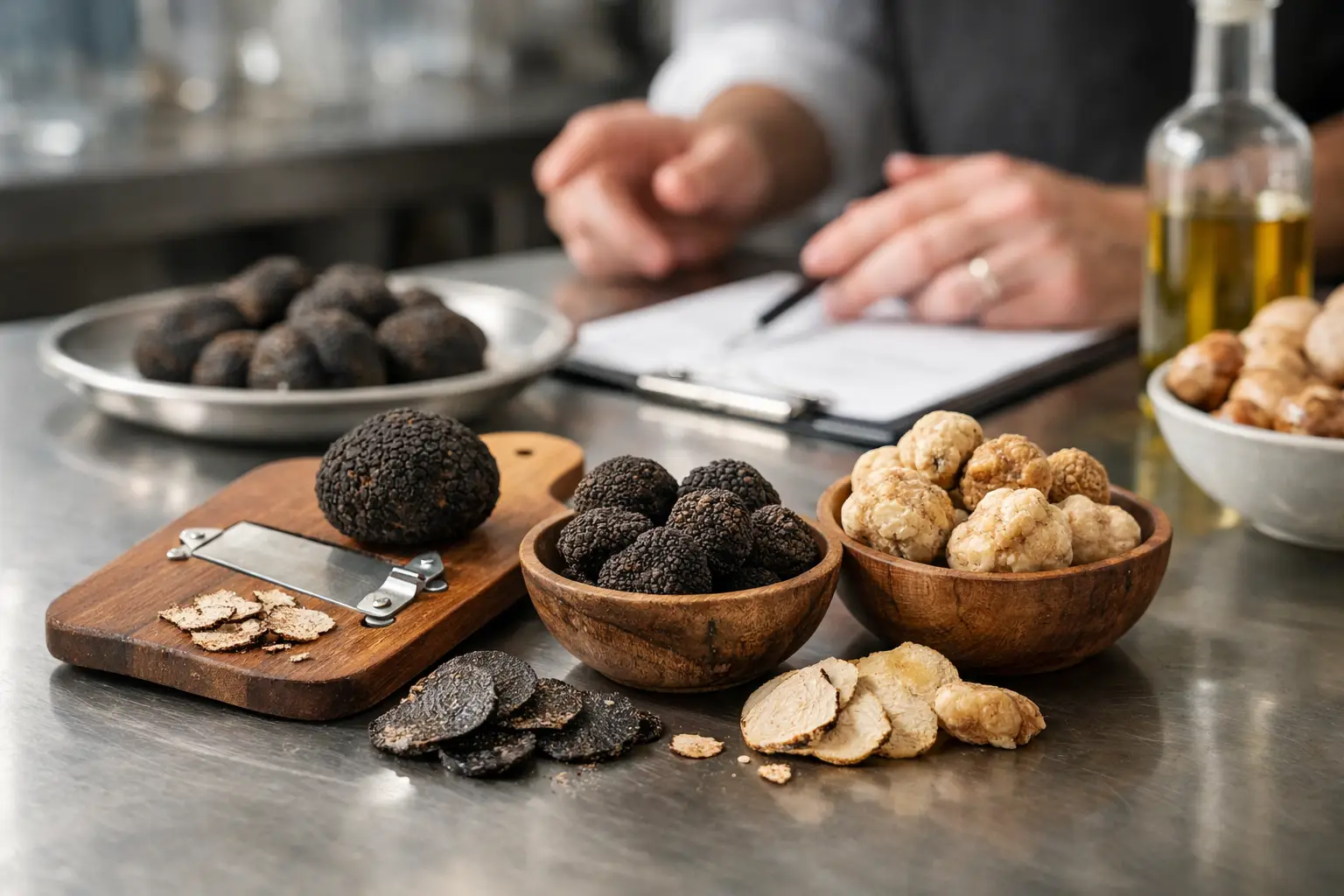
Black and white truffles behave differently on the plate. Winter black truffles bring an earthy, savory depth that pairs beautifully with beef, root vegetables, mushrooms, pasta, eggs, and rich sauces. Their structure allows for cooking in gentle heat, although prolonged high heat will mute their character. White truffles are more delicate, intensely aromatic, and best treated as a finishing ingredient over warm, neutral foods that let their garlic-like, honeyed perfume lead.
The question is not simply, “Which truffle is best?” It is, “Which truffle makes this dish worth ordering?” A polished menu may use fresh truffle sparingly as a seasonal enhancement, while relying on premium pantry ingredients to carry truffle flavor across a broader range of covers.
Buying Truffles for Restaurants by Season
Seasonality is the first discipline of truffle purchasing. Fresh European truffles are agricultural products, and their availability, aroma, and price shift throughout the year. A restaurant that builds a special around a brief seasonal window should be ready to adjust portioning and price as the market moves.
Early in a season, truffles may be less aromatic and scarcer. Later, quality can be exceptional, but demand often rises alongside it. A good supplier will communicate the variety, country or region of origin, harvest conditions, and current market reality rather than promising a fixed experience every week.
For menu planning, give fresh truffles a flexible description. “Seasonal black truffle” often provides more room than naming a specific variety months in advance. When a white truffle dish is offered, make the seasonality part of its appeal: an indulgent, limited-time moment rather than a permanent promise that forces the kitchen to purchase at an unfavorable price.
Evaluate Aroma, Firmness, and Provenance
A truffle should arrive firm for its variety, clean, and fragrant. It may carry a little natural earth, but it should never smell sour, overly fermented, or damp in an unpleasant way. A pronounced aroma is desirable, yet fresh truffles are nuanced. They should smell alive and complex, not artificially perfumed.
Provenance matters because it gives a chef useful context. European truffle regions have long-established harvest traditions, and varietal identification helps determine how a truffle will perform in the kitchen. Ask suppliers to state what is being sold rather than relying on vague language such as “premium truffle.” The distinction between a fresh winter black truffle and a less aromatic truffle variety changes the appropriate price, application, and guest expectation.
Size is not a pure measure of quality. Large, round truffles command attention for tableside shaving and present beautifully for special events. Smaller truffles can be equally aromatic and are often the practical choice for kitchen use. Buy the presentation you need, not a visual standard the dish never requires.
Order for Realistic Yield and Service
Fresh truffles lose moisture over time, even under careful storage. They also have trim loss, and a seemingly generous order can disappear quickly once the kitchen begins shaving portions during a busy service. Build a modest allowance into purchasing calculations, particularly when truffles will be used across multiple dishes or at a high-volume event.
Portion standards protect both the guest experience and food cost. For a finishing shave, the correct amount depends on the variety, aroma, and dish temperature. A delicate white truffle may need only a few memorable shavings over warm pasta, while a black truffle sauce or butter calls for a measured gram weight incorporated with care.
Train one or two people to portion fresh truffles. A microplane, truffle slicer, and scale should be treated as cost-control tools, not accessories. When every cook shaves by instinct, the last ten covers of the night can look very different from the first ten.
Menu price should reflect the true cost of the truffle, not only the purchase price per ounce. Include expected yield, labor, waste, garnish, and the cost of tying up a premium ingredient in a dish that may not sell. For some restaurants, an add-on price per gram is the clearest approach. For others, a fixed seasonal truffle supplement preserves the feeling of abundance while keeping the check average predictable.
Make Delivery Timing Part of the Purchase
The finest truffle is only as useful as its condition when service begins. Arrange delivery as close to use as possible, particularly for white truffles. Avoid receiving a large order before a day when the restaurant is closed, lightly staffed, or unable to inspect the shipment immediately.
Upon arrival, inspect, weigh, and record the truffles. Gently brush away loose soil only when preparing to use them, rather than washing them in advance. Excess moisture is the enemy of freshness. Store truffles in a sealed container lined with dry paper towel in the refrigerator, changing the towel daily. Keep them protected from strong odors and check them every day for softness or condensation.
Rice storage is often romanticized, but it can draw out moisture and accelerate weight loss. If a kitchen uses rice for a short period to perfume it for a risotto, that is a culinary choice. It should not be mistaken for the best long-term storage method.
Build a Truffle Program Beyond Fresh Season
A restaurant does not need to force fresh truffles onto the menu year-round to maintain a luxurious truffle identity. In fact, a broader program often gives chefs more control. High-quality truffle oil can finish fries, pizza, roasted vegetables, or lobster mac and cheese. Truffle salt brings immediate depth to eggs, popcorn, steak, and crisp potatoes. Truffle carpaccio, pesto nero, powder, and honey create distinct flavor directions without the volatility of a fresh market purchase.
These products are not substitutes for the theater of a freshly shaved seasonal truffle. They are different tools. A pantry truffle product offers consistency, longer shelf life, and a reliable food cost, making it especially useful for banquets, catering, bar menus, and dishes that need a signature flourish on demand.
For a restaurant program, consider using fresh truffles for a focused seasonal special and shelf-stable products for permanent menu touches. This approach lets guests enjoy the rare pleasure of a fresh truffle while giving the kitchen a dependable way to deliver truffle character every month of the year. Specialty suppliers such as Truffle Guys can help restaurants source both sides of that equation, from fresh European varieties to versatile finishing ingredients.
Choose a Supplier Like a Culinary Partner
The supplier relationship should be candid. A reliable truffle partner explains when quality is extraordinary, when supply is tight, and when another variety or format would serve the dish better. They understand that a restaurant buyer needs more than a beautiful product photo. They need accurate weights, dependable delivery, proper packing, and an honest assessment of what will arrive.
Before committing to a regular program, test the supplier with a small order. Assess aroma on arrival, condition after a day or two in your storage system, and performance during service. Compare the truffle against the dish, not in isolation. A truffle that seems subtle in a cold kitchen can become exquisite when shaved over hot buttered pasta.
The best truffle purchase creates more than a costly garnish. It gives a dish a season, a story, and a reason for guests to return before that extraordinary ingredient is gone.
