
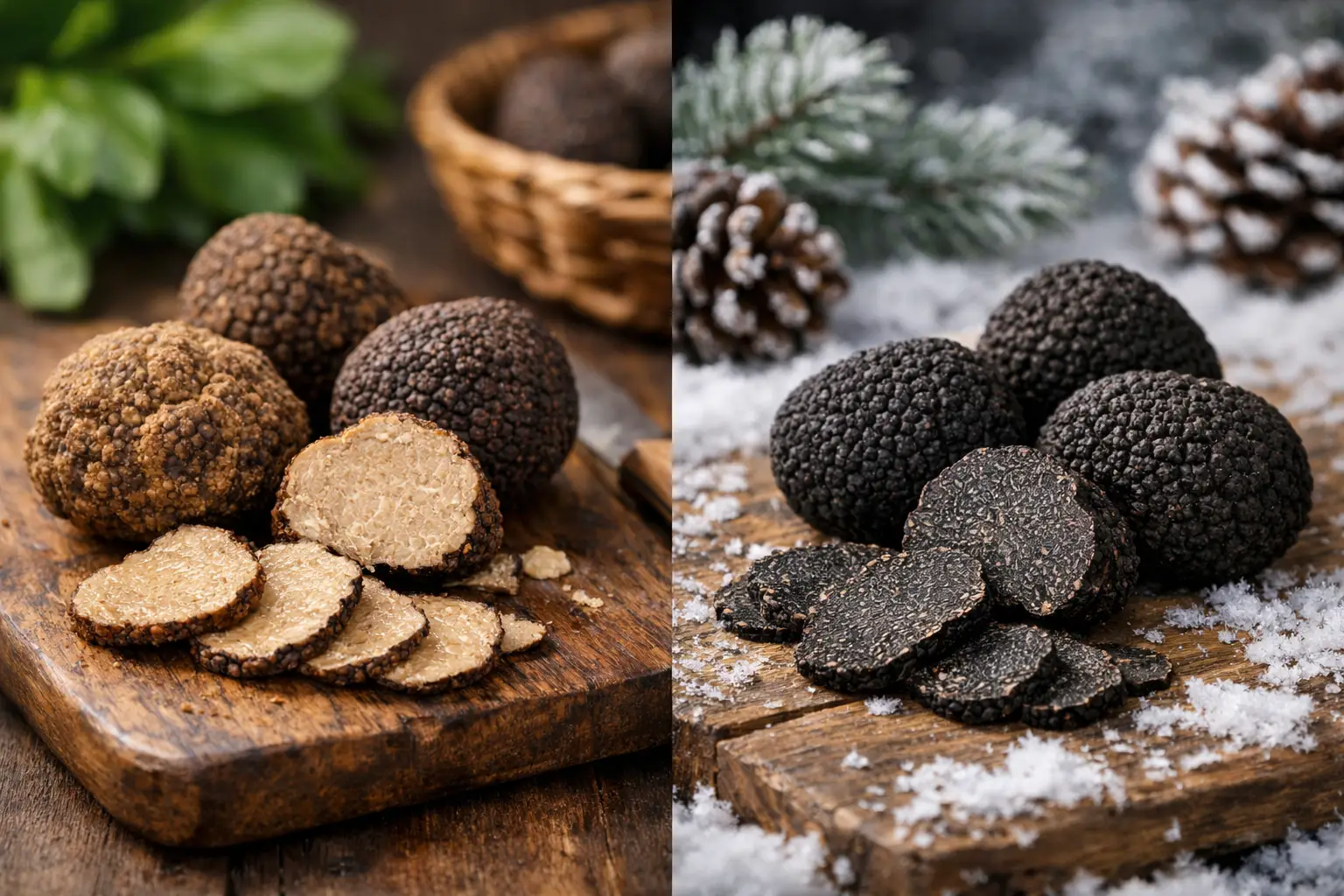
Summer Truffles vs Winter Truffles Compared Leave a comment
A plate of warm tagliatelle needs only butter, Parmigiano, and a few careful shavings to reveal why fresh truffles are so coveted. Yet summer truffles vs winter truffles is not simply a question of which season produces the more luxurious ingredient. They offer distinct aromas, textures, and culinary personalities – and choosing the right one can shape the entire dish.
For the home cook planning an elegant dinner or the chef building a seasonal menu, the difference comes down to varietal, freshness, and how the truffle will meet heat, fat, and other ingredients. Both deserve a place in the kitchen. They simply shine in different ways.
Summer Truffles vs Winter Truffles: The Essential Difference
Summer truffles are most often Tuber aestivum, commonly called the summer black truffle or Burgundy truffle. They grow across several celebrated European truffle regions and are generally harvested from late spring through summer, with timing varying by origin and weather. Their exterior is dark and deeply textured, while the interior is pale beige to tan with fine white marbling.
Their flavor is graceful rather than forceful: earthy, lightly savory, and often reminiscent of toasted hazelnuts, mushrooms, and woodland soil after rain. A fresh summer truffle can add unmistakable sophistication to a dish without taking over every other ingredient on the plate.
Winter truffles require a little more precision because the term can refer to more than one species. Tuber brumale, often called the winter black truffle, is a true winter varietal with a darker flesh and a more assertive, earthy profile than Tuber aestivum. In many luxury culinary conversations, however, “winter truffle” also points to Tuber melanosporum, the celebrated Périgord black truffle. This is the intensely aromatic black truffle prized from late fall into winter.
That distinction matters when buying fresh truffles. Ask for the varietal, not just the seasonal label. A winter black truffle and a Périgord black truffle can both be exceptional, but they are not interchangeable in aroma, availability, or price.
Aroma Is Where the Difference Becomes Obvious
Summer truffles have an inviting but comparatively delicate fragrance. Think fresh mushrooms, nuts, warm earth, and a subtle sweetness. Their gentler character makes them especially appealing when you want an elegant finishing touch that lets seasonal produce, fine olive oil, or a beautiful cheese remain part of the conversation.
Winter black truffles tend to arrive with greater intensity. Tuber brumale can be deeply earthy, musky, and slightly peppery. Tuber melanosporum is often more complex still, carrying notes that chefs describe as cocoa-like, savory, mineral, and profoundly aromatic. It perfumes a room when freshly shaved over a hot dish.
Neither is inherently “better.” A Périgord black truffle may create the more dramatic special-occasion moment, while a summer truffle can be the smarter choice for a spring risotto, a composed salad with soft egg, or an evening when you want generous shavings without overwhelming the meal or the budget.
A note on white truffles
White truffles occupy their own category. The revered Italian white truffle, Tuber magnatum, is usually harvested from fall into early winter and has a famously pungent perfume with notes of garlic, cheese, and honeyed earth. It is frequently grouped into conversations about winter truffles because of its season, but its flavor and handling are entirely distinct from black truffles. White truffles are almost always shaved raw over warm food, never cooked into it.
Seasonality, Availability, and Price
Fresh truffles are agricultural treasures, not manufactured luxuries. Their availability depends on rainfall, soil conditions, harvest regulations, and the success of trained truffle dogs in finding mature specimens. The calendar provides a useful guide, but nature has the final say.
Summer truffles are typically more abundant and accessible. Their more moderate price can make them ideal for entertaining, especially when you want to shave a satisfying amount across several portions. They bring a refined truffle presence to a dinner party without requiring every component to be built around a single precious ingredient.
Winter truffles are usually scarcer and command a higher price, particularly at the peak of Périgord black truffle season. Their concentrated aroma means you may need less to make an impact, but they should be treated with intention. Choose a simple dish, use excellent supporting ingredients, and serve it immediately after shaving.
Freshness matters as much as season. A truffle should feel firm and weighty for its size, with an aroma that is clear and enticing rather than faint, fermented, or damp. Once received, wrap it in a dry paper towel, place it in an airtight container, and refrigerate it. Change the towel daily and enjoy the truffle promptly. Its fragrance is at its most exquisite when it is freshly harvested and carefully stored.
How to Cook With Each Truffle
The rule for both summer and winter truffles is straightforward: avoid aggressive heat. Long cooking dulls the volatile aromatic compounds that make truffles remarkable. Instead, let residual warmth carry their fragrance upward just before serving.
Summer truffles are beautifully suited to dishes with a clean, buttery base. Fold thin shavings into soft scrambled eggs just off the heat, layer them over a creamy potato gratin, or finish pasta tossed with butter, pasta water, and aged Parmesan. Their nutty character also pairs naturally with corn, asparagus, peas, fresh ricotta, and poultry.
For a more casual but still indulgent use, shave summer truffle over pizza after it leaves the oven, or tuck slices into a warm brie and mushroom tart. A pinch of black truffle salt can reinforce the savory foundation, but use it with restraint so the fresh truffle remains the star.
Winter black truffles call for richer, more restrained preparations. Fresh pasta, risotto, celeriac purée, roasted chicken, and buttery scrambled eggs provide the ideal canvas. A velvety sauce made with cream or stock can work beautifully, provided the truffle is added at the end rather than simmered for a long time.
With a powerful Périgord black truffle, simplicity becomes a form of generosity. Fresh egg pasta dressed in butter and Parmigiano, then finished with truffle shavings, gives the aroma nowhere to hide. Skip strong garlic, hot chile, heavily smoked ingredients, or an overly acidic sauce. They can flatten the subtle layers you paid for.
Choosing the Right Truffle for the Occasion
Choose summer truffles when you are serving a crowd, celebrating warm-weather produce, or looking for an approachable entry into fresh truffle cooking. Their flavor is refined, versatile, and easy to layer across a menu. They are particularly rewarding when used generously.
Choose winter truffles when the dish is intentionally spare and the truffle is the evening’s focal point. Their deeper aroma suits colder-weather ingredients, richer textures, and intimate meals where every shaving can be appreciated. If a product is labeled simply as winter truffle, check the species before setting expectations about flavor or intensity.
When fresh truffles are out of season, high-quality pantry ingredients can keep the pleasure close at hand. Black truffle oil, truffle carpaccio, truffle powder, and sea salt offer dependable ways to add savory depth to fries, popcorn, roasted vegetables, pasta, and eggs. They are not replacements for the fleeting perfume of a fresh truffle, but they are valuable ingredients in their own right – especially for effortless weekday luxury.
The best choice is the one that suits the dish in front of you. Let a summer truffle bring soft, nutty elegance to a generous table, or let a winter truffle turn a humble bowl of pasta into the kind of meal guests remember long after the last shaving disappears.
